Medically reviewed and last Updated on 09/10/2026
Overview
Plaque is a soft, sticky bacterial biofilm that forms on your teeth every day. Tartar is plaque that has hardened on the teeth and cannot be removed with regular brushing or flossing.
Understanding plaque vs. tartar matters because both can affect your teeth and gums. Plaque can usually be controlled at home. Once it becomes tartar, professional dental cleaning is needed.
At Dent Blanche Dental in Princeton, NJ, our team helps patients prevent and remove plaque and tartar to protect their teeth, gums, and long-term oral health.
Key takeaways
- Plaque is soft and sticky. You can remove it with effective brushing and interdental cleaning.
- Tartar is hardened plaque. It requires professional removal.
- Plaque is usually colorless or pale yellow.
- Tartar may appear yellow, brown, or darker.
- Both plaque and tartar can contribute to gum inflammation and dental problems.
- Daily oral hygiene helps prevent plaque from hardening into tartar.
- Regular dental exams and professional cleanings help control buildup that home care cannot remove.
Plaque vs. tartar: a comparison
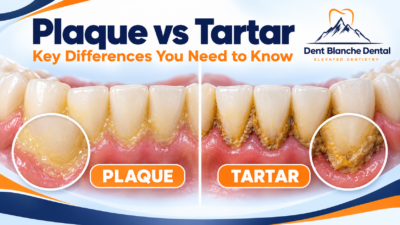
The main difference between plaque and tartar is that plaque is a soft bacterial biofilm, while tartar is mineralized plaque that has hardened onto a tooth surface.
Plaque
Texture: Soft and sticky
Color: Usually colorless or pale yellow
Where it forms: On and between teeth and near the gumline
Can you remove it at home? Yes
How: Brushing and interdental cleaning
Main risks: Cavities and gum inflammation
Tartar
Texture: Hard and rough
Color: Often yellow or brown and sometimes darker
Where it forms: Above or below the gumline
Can you remove it at home? No
How: Professional dental cleaning
Main risks: Gingivitis and progression of periodontal disease in susceptible patients
So, is tartar and plaque the same?
No. Plaque comes first. Tartar forms when plaque remains long enough to mineralize and harden.
What is dental plaque?

#Dental Plaque vs Tartar
Dental plaque is a sticky bacterial biofilm that continually develops on your teeth.
Bacteria in plaque interact with sugars and other fermentable carbohydrates from food and drinks. The acids produced by these bacteria can contribute to tooth decay.
Plaque accumulating near the gums can also trigger inflammation.
Key facts about plaque
- Plaque constantly forms on teeth.
- It often feels soft or sticky.
- It may be difficult to see.
- It collects around the gumline and between teeth.
- Effective brushing removes plaque from accessible tooth surfaces.
- Floss or other interdental cleaners help remove plaque between teeth.
- Plaque that remains on teeth can eventually mineralize into tartar.
If your teeth feel “fuzzy” or coated, especially near the end of the day, plaque may be accumulating on the tooth surfaces.
What is tartar (dental calculus)?
Tartar, also called dental calculus, is plaque that has mineralized and hardened onto the teeth.
Minerals in saliva contribute to this hardening process. Once calculus attaches to a tooth, normal brushing and flossing cannot reliably remove it.
What does tartar look like on teeth?
Tartar may look like:
- Yellow deposits near the gumline
- Brown buildup between teeth
- Hard deposits behind the lower front teeth
- Darker deposits when calculus develops below the gumline or becomes stained
- Rough, crust-like buildup on tooth surfaces
The back of the lower front teeth is a common place for tartar to accumulate because of the nearby openings of major salivary glands.
Key facts about tartar
- Tartar develops from mineralized dental plaque.
- It feels hard rather than sticky.
- It can form above or below the gumline.
- It cannot be adequately removed with a toothbrush or floss.
- It provides a rough surface where additional plaque can accumulate.
- Professional instruments are needed for safe removal.
Brown or dark material on a tooth is not automatically tartar. Tooth decay and external staining can sometimes look similar. A dental examination can determine the cause.
How does plaque turn into tartar?
Plaque that remains undisturbed can absorb minerals from saliva and begin to harden.
The process generally follows these steps:
- Plaque develops. Bacteria form a biofilm on the teeth.
- Plaque accumulates. Areas missed during brushing and interdental cleaning retain more plaque.
- Minerals enter the plaque. Minerals from saliva begin the mineralization process.
- Plaque hardens. The soft biofilm becomes dental calculus or tartar.
- More plaque collects. Tartar’s rough surface can make additional plaque retention easier.
This is one reason consistent daily oral hygiene matters.
How to remove plaque from teeth
You can control most dental plaque at home with good daily oral hygiene.
Brush twice daily
Brush your teeth twice a day for two minutes with fluoride toothpaste.
Use a soft-bristled toothbrush and clean:
- Outer tooth surfaces
- Inner tooth surfaces
- Chewing surfaces
- Along the gumline
Electric and manual toothbrushes can both be effective when used properly.
Floss or clean between your teeth daily
A toothbrush cannot effectively clean every surface between neighboring teeth.
Use:
- Dental floss
- Interdental brushes
- Water flossers when appropriate
- Other dentist-recommended interdental cleaners
Choose a method you can use consistently and correctly.
Use mouthwash when appropriate
A therapeutic mouthrinse may complement brushing and interdental cleaning for some patients.
However, mouthwash does not replace brushing or cleaning between the teeth.
Watch frequent sugar intake
Frequent exposure to sugary foods and drinks gives acid-producing plaque bacteria more opportunities to contribute to tooth decay.
Try to limit frequent snacking and sugary beverages.
Schedule professional dental cleanings
Professional cleanings remove deposits that you cannot adequately remove at home.
Your recommended cleaning interval should be based on your individual oral health and periodontal condition rather than a one-size-fits-all schedule.
How to remove tartar
You should not try to scrape tartar from your teeth at home.
Once plaque has hardened into calculus, professional instruments are needed to remove it safely and thoroughly.
Trying to remove tartar with sharp or metal objects can:
- Injure your gums
- Scratch tooth or root surfaces
- Cause bleeding
- Leave calculus behind
- Make it difficult to recognize an underlying dental problem
During a professional cleaning, a dental hygienist or dentist uses specialized instruments to remove plaque and calculus.
Patients with periodontal disease may require scaling and root planing, often called a deep cleaning, rather than a routine preventive cleaning.
Learn more about dental deep cleaning.
What happens if plaque and tartar aren’t removed?
Plaque and tartar can contribute to several oral health problems when buildup persists.
Plaque left untreated can contribute to:
- Tooth decay
- Cavities
- Gingivitis
- Bleeding gums
- Bad breath
- Tartar formation
Plaque control is therefore an important part of both cavity prevention and gum health.
Tartar left untreated can contribute to:
- Persistent plaque retention
- Gum inflammation
- Gingivitis
- Periodontal disease
- Gum recession
- Periodontal bone loss
- Tooth mobility and eventual tooth loss in advanced periodontal disease
Tartar itself is not simply a cosmetic concern. Its rough surface provides an environment where plaque can continue to accumulate.
If your gums bleed, appear swollen, or have started pulling away from your teeth, schedule a periodontal evaluation.
How to prevent plaque and tartar buildup
The best strategy is to control plaque before it mineralizes into tartar.
For healthier teeth and gums:
- Brush twice daily with fluoride toothpaste.
- Clean between your teeth every day.
- Brush carefully along the gumline.
- Limit frequent sugary foods and drinks.
- Drink water throughout the day.
- Avoid tobacco products.
- Schedule regular dental examinations.
- Have professional cleanings at the interval recommended for your oral health.
Patients with periodontal disease, heavy calculus buildup, dental implants, or other risk factors may need professional maintenance more frequently.
Plaque vs. tartar FAQs
How long does it take for plaque to turn into tartar?
Plaque can begin mineralizing relatively quickly when it remains undisturbed. The exact rate varies based on saliva, oral hygiene, location in the mouth, and individual factors.
Daily plaque removal helps prevent this process.
Can tartar be removed at home?
No. Once tartar has hardened onto a tooth, brushing and flossing cannot reliably remove it.
A dental professional can safely remove calculus with specialized instruments.
Is plaque or tartar worse for your teeth?
Both matter.
Plaque contains bacteria that contribute to cavities and gum inflammation. Tartar is hardened plaque that cannot be removed through routine home care and provides a rough surface where additional plaque can accumulate.
Preventing plaque buildup is the best way to reduce tartar formation.
What does tartar look like?
Tartar commonly appears as a hard yellow or brown deposit near the gumline or between teeth.
It may also accumulate behind the lower front teeth. Deposits below the gumline can be difficult or impossible to see without a professional examination.
Why do I have brown plaque on my teeth?
What appears to be brown plaque may actually be tartar, external staining, or another dental condition.
Coffee, tea, tobacco, and certain foods can stain plaque and calculus.
Because brown areas can sometimes represent tooth decay rather than tartar, have persistent discoloration evaluated by a dentist.
Why does tartar build up on the back of my teeth?
Tartar commonly develops behind the lower front teeth because this area is close to the openings of salivary glands.
Plaque in this area can mineralize readily if it is not removed effectively.
How often should I get tartar removed?
There is no single cleaning interval appropriate for every patient.
Your dentist and hygienist may recommend preventive cleanings or periodontal maintenance based on your:
- Gum health
- Amount of tartar buildup
- Periodontal history
- Home care
- Dental restorations and implants
- Individual risk factors
Can tartar break off your teeth?
Pieces of heavy tartar can sometimes break away.
However, that does not mean all of the calculus has been removed. Do not scrape the remaining buildup yourself.
Schedule a dental evaluation and professional cleaning.
How do I know if I have tartar on my teeth?
Tartar often feels hard and rough and does not brush away.
Common signs include:
- Yellow or brown deposits near the gums
- Hard buildup behind the lower front teeth
- Rough areas along the gumline
- Persistent bad breath
- Bleeding or inflamed gums
A dental examination is the best way to determine whether a deposit is plaque, tartar, staining, or another dental problem.
Dent Blanche Dental can help with plaque and tartar removal
Plaque can usually be controlled at home. Tartar requires professional removal.
At Dent Blanche Dental in Princeton, NJ, our dental team provides preventive and periodontal care based on your individual needs.
We can evaluate your teeth and gums, remove plaque and tartar, and determine whether you need a routine cleaning or periodontal treatment.
Regular preventive care can help you:
- Reduce plaque and tartar buildup
- Protect your gums
- Detect cavities earlier
- Maintain existing dental work
- Protect dental implants
- Maintain a healthier smile
Schedule a dental cleaning in Princeton, NJ
If you can see or feel hard tartar on your teeth, don’t try to scrape it off yourself.
Schedule a professional evaluation at Dent Blanche Dental in Princeton, NJ.
Call 609-890-1888 or schedule an appointment online.
Early prevention is easier than treating advanced tooth decay or periodontal disease.
Medically reviewed by Dr. Radwa Saad.