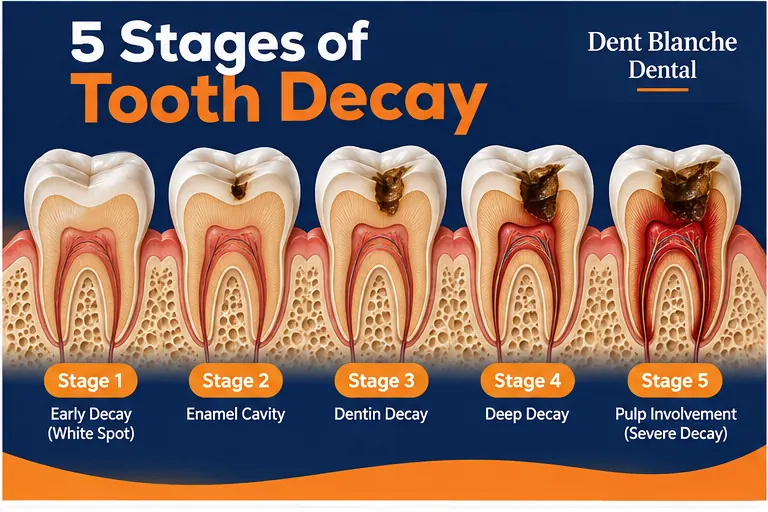
Stages of Tooth decay progresses through five main stages: enamel demineralization, enamel cavities, dentin decay, pulp damage, and dental abscess. Early decay may appear as a chalky white spot, while advanced cavities can cause dark holes, pain, and infection.
At Dent Blanche Dental in Princeton, NJ, we use digital imaging and comprehensive dental examinations to detect cavities early and help preserve your natural teeth.
Overview: What Does Tooth Decay Look Like?
Stages of Tooth decay, also called dental caries, develops when plaque bacteria produce acids that remove minerals from teeth.
Initially, you may notice a white spot or small brown area. However, some cavities remain invisible without a dental examination or X-rays.
As decay progresses, it can damage the enamel, dentin, and eventually the tooth’s inner pulp.
Key Takeaways
- Early cavities may appear white, yellow, brown, or dark.
- Stage 1 tooth decay can sometimes be reversed before a hole develops.
- Cavities that form holes generally require professional treatment.
- Dentin decay may cause sensitivity to sweets or cold drinks.
- Deep cavities can lead to toothaches, infection, and abscesses.
- Dental X-rays help identify hidden decay between teeth.
- Early treatment usually preserves more natural tooth structure.
What Are the 5 Stages of Tooth Decay?

| Stages of Tooth Decay | Appearance | Common treatment |
|---|---|---|
| 1. Demineralization | Chalky white spot | Fluoride and preventive care |
| 2. Enamel cavity | Small pit or dark spot | Monitoring or filling, depending on severity |
| 3. Dentin decay | Larger cavity beneath enamel | Dental filling or restoration |
| 4. Pulp involvement | Deep cavity, sometimes with severe pain | Root canal or extraction |
| 5. Dental abscess | Infection, sometimes swelling or gum bump | Urgent dental treatment |
These stages describe a common pattern, not a rigid timeline. Cavities can progress differently depending on their location and individual risk factors.
What are the Stages Of Tooth Decay with Pictures?
Stage 1 Tooth Decay: White Spots and Early Cavities

The first stage begins when acids remove minerals from tooth enamel.
What Does an Early Cavity Look Like?
Early cavity pictures often show:
- Chalky white spots
- Dull or opaque enamel
- White areas near the gumline
- Changes around orthodontic brackets
This is sometimes called a pre-cavity or incipient caries lesion.
Can Stage 1 Tooth Decay Be Reversed?
Yes. Non-cavitated enamel lesions can sometimes remineralize.
Your dentist may recommend fluoride toothpaste, professional fluoride treatments, improved brushing, and dietary changes.
However, not every white spot is tooth decay. Some result from developmental enamel changes or other conditions.
Stage 2 Tooth Decay: Enamel Cavities

At this stage, decay affects the outer enamel.
A small cavity may appear as a brown spot, dark groove, or visible pit.
What Does a Small Cavity Look Like?
Small cavity pictures may show:
- Brown or black spots on molars
- Tiny holes in chewing surfaces
- Dark areas between teeth
- Early decay on front teeth
Nevertheless, a dark spot does not automatically mean a cavity. Some stains are harmless, while active decay can remain hidden beneath the surface.
Treatment for Enamel Decay
Non-cavitated lesions may be managed with preventive treatment.
Once the enamel surface breaks down and forms a hole, a filling or another restorative procedure is often necessary.
Stage 3 Tooth Decay: Dentin Decay

Dentin is the softer layer beneath enamel.
When decay reaches dentin, it may spread more quickly and cause sensitivity.
What Does Dentin Decay Look Like?
Dentin decay pictures may show a brown or dark cavity extending beneath the enamel.
Common symptoms include:
- Sensitivity to sweets
- Discomfort with cold drinks
- Food trapping
- Visible holes
- Occasional chewing discomfort
However, some dentin cavities cause no symptoms.
How Is Dentin Decay Treated?
Your dentist may recommend a tooth-colored filling, an inlay, or a crown depending on the cavity’s size and depth.
Selected early dentin lesions can sometimes be managed without drilling under professional supervision, but a formed cavity often needs restoration.
Stage 4 Tooth Decay: Deep Cavities and Pulp Damage

Advanced tooth decay can reach the pulp, which contains nerves and blood vessels.
What Does a Deep Cavity Look Like?
A severe cavity may appear as:
- A large brown or black hole
- Broken or weakened tooth structure
- Extensive decay around an old filling
- A deep cavity in a back molar
Symptoms may include lingering sensitivity, spontaneous toothaches, or pain when chewing.
Treatment for Advanced Tooth Decay
If the pulp becomes irreversibly inflamed or infected, treatment may involve:
- Root canal therapy
- A buildup and dental crown
- Tooth extraction if the tooth cannot be restored
At Dent Blanche Dental, eligible patients may benefit from CEREC same-day crowns following appropriate restorative treatment.
Stage 5 Tooth Decay: Dental Abscess
An untreated infected tooth may develop a dental abscess.
An abscess is a collection of pus caused by infection. It may occur near the tooth root or in surrounding tissues.
What Does an Abscessed Tooth Look Like?
Possible signs include:
- Swollen or tender gums
- A pimple-like bump on the gum
- Persistent bad taste
- Facial swelling
- Throbbing pain
- Fever
Some abscesses cause little pain, so the absence of a toothache does not rule out infection.
When Is Tooth Decay an Emergency?
Seek urgent dental care for a suspected abscess.
If swelling spreads rapidly or you experience difficulty breathing or swallowing, seek emergency medical care immediately.
Treatment may involve root canal therapy, drainage, extraction, and antibiotics when clinically indicated.
Antibiotics alone do not eliminate the underlying source of most dental infections.
Where Do Cavities Form?
Tooth decay can affect different surfaces.
Cavities in Molars
Back teeth have deep grooves that trap plaque and food. A cavity on a molar may appear as a dark pit or hole.
Cavities Between Teeth
Decay between teeth is often difficult to see without dental X-rays.
Front Tooth Cavities
Front tooth decay may appear near the gumline, between teeth, or on the visible surface.
Gumline and Root Cavities
Receding gums expose root surfaces, which are more vulnerable to decay.
Cavity vs. Stain: How Can You Tell?
| Feature | Tooth stain | Possible cavity |
|---|---|---|
| Color | Brown, yellow, or black | White, brown, yellow, or black |
| Surface | Often smooth | May be rough, softened, or pitted |
| Sensitivity | Usually absent | May occur |
| Progression | May remain unchanged | Can worsen without treatment |
| Treatment | Cleaning or cosmetic care | Prevention or restorative treatment |
Only a dental examination can reliably distinguish stains from cavities.
What Do Cavities Look Like on X-Rays?
Dental cavities often appear as darker areas on X-rays because decayed tooth structure is less dense.
Bitewing X-rays are particularly helpful for detecting cavities between teeth.
However, very early enamel changes may not appear on X-rays, and not every dark area represents decay.
Your dentist combines imaging with a clinical examination to make a diagnosis.
How to Prevent Tooth Decay
You can reduce your risk of cavities with consistent daily care.
- Brush twice daily with fluoride toothpaste.
- Clean between your teeth every day.
- Limit frequent sugary snacks and drinks.
- Drink water throughout the day.
- Schedule regular dental examinations.
- Ask about fluoride treatments and dental sealants.
- Address dry mouth and other cavity risk factors.
Most importantly, treat early decay before it becomes a larger cavity.
Frequently Asked Questions About Stages of Tooth Decay
What Does the Beginning of Tooth Decay Look Like?
Early decay often appears as a chalky white spot, especially near the gumline or around orthodontic brackets.
Can You See a Cavity on Your Tooth?
Sometimes. Visible cavities may look like brown spots, pits, or holes. However, decay between teeth can remain hidden.
Are Cavities White or Black?
Both are possible. Early enamel demineralization can look white, while more advanced decay may appear brown or black.
What Is the Difference Between Demineralization and a Cavity?
Demineralization means the enamel has lost minerals. A cavity develops when decay causes structural breakdown and a hole forms.
What Does a Cavity Between Teeth Look Like?
It may appear as a dark area near the contact point, but many cavities between teeth are detected through dental X-rays.
What Does a Cavity Look Like on a Molar?
A molar cavity may appear as a dark groove, small pit, or larger hole on the chewing surface.
Can a Stage 1 Cavity Heal?
An early non-cavitated enamel lesion may remineralize with fluoride and appropriate preventive care.
Can a Stage 3 Cavity Be Reversed?
Once a cavity has formed in dentin, it generally cannot regrow lost tooth structure. Treatment depends on the lesion’s depth and activity.
What Does Advanced Tooth Decay Look Like?
Advanced decay may cause a large hole, broken tooth structure, dark discoloration, or an abscess.
How Quickly Does Tooth Decay Progress?
Progression varies. Some lesions develop slowly over years, while others advance more rapidly, especially in patients with high cavity risk.
What Is a Pop Cavity?
“Pop cavity” is not a standard dental diagnosis. Patients may use it to describe a hole, pit, or cavity that seems to appear suddenly.
Can You Have Cavities Without Pain?
Yes. Early and even some advanced cavities may cause no noticeable symptoms.
Dental Cavity Treatment in Princeton, NJ
Whether you have a small cavity, tooth sensitivity, or signs of advanced decay, early diagnosis can help preserve your smile.
At Dent Blanche Dental, Dr. Radwa Saad and our team offer preventive and restorative dentistry, including tooth-colored fillings, root canal evaluations, and same-day crowns when appropriate.
Don’t wait for a small cavity to become a painful dental emergency.
Schedule Your Dental Appointment
Dent Blanche Dental
3640 Lawrenceville Road, Princeton, NJ 08540
Phone: 609-890-1888