
How to choose the right dental implant type? What types of dental implants are best for cosmetic improvements? Most patients researching this question spend weeks comparing brands and pricing, and rarely stop to ask what actually determines whether the final result looks like a natural tooth or a placeholder: which implant type, which material, and which combination of crown and soft-tissue support will put the right tooth in the right place with the right gum frame around it.
This guide covers the implant types, materials, and foundation factors that shape appearance, and it arms you with specific questions to bring to your next consultation so you can evaluate whether a provider truly prioritizes esthetic outcomes.
How to choose the right dental implant type: What types of dental implants are best for cosmetic improvements?
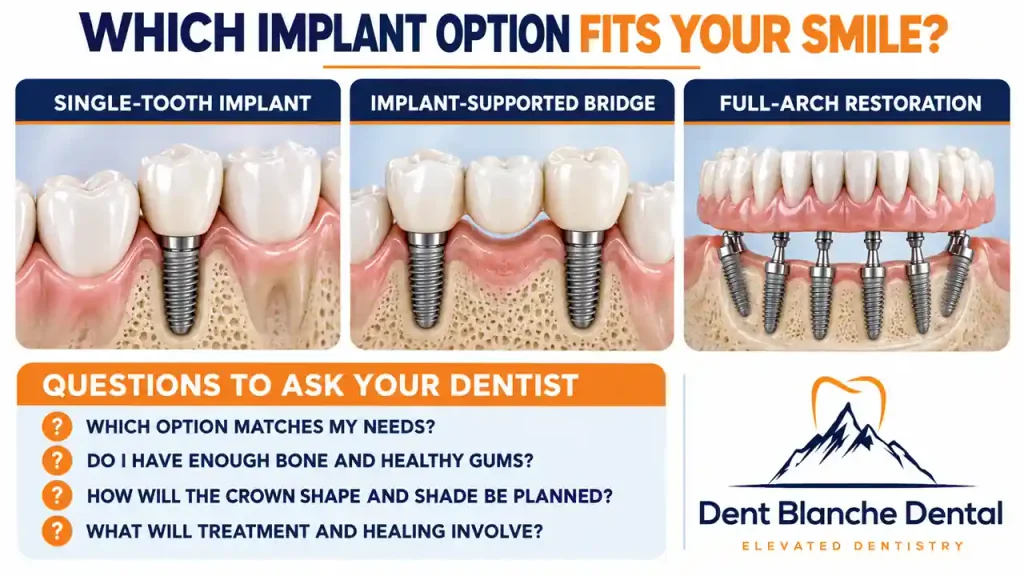
Single-tooth implants for front teeth
A single-tooth implant is generally the gold standard when one front tooth is missing. It allows precise control over crown shape, shade, and gum contour, and it preserves the adjacent natural teeth entirely. Placement in the esthetic zone demands exact three-dimensional positioning, small deviations in placement can noticeably affect how the gum frames the visible tooth.
Implant-supported bridges for adjacent gaps
When two or three teeth are missing in the smile zone, an implant-supported bridge is a strong alternative to individual implants, particularly when bone between the missing teeth is limited. The bridge design must account for the pontic (the artificial tooth suspended between crowns) and how the gum contact looks from the front. There are fewer cosmetic control points than with individual implants, but the result can still be highly natural when planned carefully.
All-on-4 and full-arch restorations for whole-smile transformation
All-on-4 and full-arch solutions make the most cosmetic sense when most or all teeth in an arch are failing or already gone. The prosthesis uses a continuous arch with an artificial gum-colored base, which creates a coordinated, uniform appearance. The trade-off is that this artificial base may be visible under a high smile line. Individual implants offer more precise front-tooth customization, while full-arch restorations excel at restoring facial support and lip volume after severe tooth loss.
Titanium vs. zirconia: what the difference means for your smile
Why zirconia has an edge for visible front teeth
Zirconia’s white, tooth-like color prevents the blue-gray shadow that a titanium post can cast through thin or translucent gum tissue. Zirconia is particularly favored when the implant will sit in a location where future gum recession is possible, or when the patient has a thin gum phenotype or a high smile line. This is not a minor detail: gum recession exposing a titanium margin is a well-recognized long-term esthetic concern that patients and clinicians plan around from the start.
The hybrid approach: a commonly used compromise
A commonly used approach for esthetic-zone cases is a titanium implant paired with a custom zirconia abutment and an all-ceramic crown. This combination delivers excellent esthetics while retaining titanium’s mechanical track record. Everything at the bone level remains titanium; everything from the gum line up stays tooth-colored and light-diffusing. Consider this approach when a patient values both long-term structural reliability and a seamless anterior appearance.
What material choice cannot fix
Zirconia cannot compensate for a poorly placed implant, collapsed bone, or inadequate gum volume. The bigger cosmetic factors are three-dimensional implant positioning, facial bone thickness, soft-tissue volume, and the emergence profile carved into the crown. The final appearance depends heavily on all of these variables, not on implant material alone. Patients who focus only on the titanium-versus-zirconia question are asking the second question before they have answered the first.
How to choose the right dental implant type: How your crown and abutment choices shape the final look
Abutment material and the emergence profile
The abutment is the connector between the implant and the crown, and its shape, color, and customization directly affect how the crown appears to emerge from the gum. A custom-milled zirconia abutment on a titanium base creates a natural-looking transition zone and is the leading esthetic choice for front-tooth implants. A poorly contoured or stock metal abutment can make even a well-made crown look artificial or cause visible gum blanching.
Lithium disilicate vs. high-translucency zirconia crowns
For esthetics, the general hierarchy works like this: lithium disilicate (e.max) provides the best optical translucency and depth for front teeth when the underlying abutment is tooth-colored. Published comparative research has shown lithium disilicate to have greater translucency than tested zirconias. High-translucency zirconia is the stronger alternative when more masking is needed or bite forces are heavier. When the underlying substrate is a dark titanium background, zirconia with a carefully selected opaque cement typically outperforms lithium disilicate because opacity matters more than translucency in that scenario.
Screw-retained vs. cemented: which connection serves cosmetics better
Cemented restorations generally offer the greatest cosmetic control: cement shade can be matched to mask or complement the underlying structure, and the margin can be refined for a seamless finish. Screw-retained restorations are more retrievable and avoid excess cement around the implant, but the screw-access channel must be filled with composite, which can affect the final appearance. For high-visibility anterior cases, a cemented lithium-disilicate crown on a ceramic abutment remains a widely supported cosmetic choice in the clinical literature.
Why gum and bone health determine the result more than your crown choice
Soft tissue grafting: building the gum frame
Thin gum tissue shows implant components through it and recedes over time, eventually exposing margins. A connective tissue graft adds bulk, improves the gum contour around the crown, and protects the emergence profile. Grafting can often be performed at the same time as implant placement, minimizing extra visits, though the graft still needs several weeks to mature before the restoration is loaded.
Bone grafting and guided bone regeneration
Socket preservation at extraction holds ridge volume. Localized guided bone regeneration addresses horizontal bone defects so the implant can be placed in the ideal prosthetic position, not just where bone happens to remain. Sinus lifts serve upper-jaw posterior cases with insufficient bone height. Staged guided bone regeneration commonly requires about four to six months of healing before implant placement, and soft-tissue grafting staged between procedures requires roughly eight to ten weeks for tissue stabilization before proceeding.
What a realistic cosmetic implant timeline looks like
A straightforward single-tooth case with no grafting can move from extraction to final crown in roughly four to six months. Cases requiring staged bone grafting can extend to twelve to eighteen months. Same-day crown technology can compress the final restoration phase, but the biology of osseointegration and gum maturation cannot be rushed: the timeline exists to protect the esthetic result, not slow it down. Dent Blanche Dental offers same-day crowns to help reduce the number of visits during that final phase.
Who is actually a good candidate for cosmetic implant treatment?
The high smile line challenge
Patients who show significant gum when they smile face the highest cosmetic demands from implant treatment. Any visible transition between the prosthesis and natural tissue, any gum discoloration, or minor asymmetry in gum height becomes immediately noticeable at that smile line. For these patients, soft tissue management, gum-level design, and precise crown contouring are non-negotiable parts of the treatment plan, not optional upgrades.
Gum phenotype and bone volume as candidacy factors
Research has shown that thin gum tissue is more prone to midfacial recession, papilla shrinkage, and visible show-through from the implant or abutment. Thick gum tissue provides greater soft-tissue volume and better resistance to remodeling and recession. A thin phenotype is not a contraindication, but it calls for a more protective plan: often including soft-tissue thickening, precise palatal implant positioning, and meticulous long-term maintenance.
Patients with thick gums and adequate facial bone have more cosmetic margin for error, while thin-tissue patients with borderline bone volume need more preparatory work to achieve a stable long-term result.
Questions to ask your dentist before committing to cosmetic implants: How to choose the right dental implant type?
The questions that reveal a cosmetic-first approach
These questions shift the conversation from “do you place implants?” to “do you plan implants with cosmetic outcomes in mind?” A dentist who answers each with specifics is one who thinks prosthetically first, not just surgically. Bring these to any implant consultation:
- Will you use a custom or stock abutment for my case?
- What crown material do you recommend given my smile line and gum type?
- Will I need soft tissue or bone grafting, and how does that change my timeline?
- Can I see before-and-after photos of similar cases you have completed?
- Will I have a provisional tooth during healing toshape the gum contour?
- How will you position the implant to serve the final cosmetic result, not just available bone?
- Who designs and fabricates the restoration, and does your lab routinely handle highly visible anterior cases?
A strong esthetic consultation should produce a specific visual plan you understand and can approve before any irreversible treatment begins. Be cautious if a dentist cannot show comparable cases, dismisses the questions above, or pressures you to begin without a preview.
How Dr. Radwa Saad approaches cosmetic implant planning at Dent Blanche Dental
Our welcoming, modern environment reflects our commitment to natural-looking, carefully crafted smiles. If you are weighing your dental implant options for cosmetic improvements, reach out to our team to book a consultation and discuss which combination of implant type, material, and restoration gives your specific smile zone the best possible outcome.
The best dental implants for cosmetic improvements are the ones planned for you
The most natural-looking implant result is not necessarily the most expensive or the newest option. It comes from choosing the right combination for your specific gum type, bone volume, smile line, and cosmetic goals. Single-tooth implants, All-on-4 solutions, crown materials, and custom abutments, these are tools. The esthetic outcome depends entirely on how they are combined and planned from the start.
You now have the framework to ask the right questions at your next consultation. Use them to identify a provider who treats cosmetic outcomes as seriously as clinical ones. At Dent Blanche Dental, we are ready to walk Princeton-area patients through exactly this process, from the first conversation about your smile to the final crown that fits seamlessly into it. Get in touch with our team to take the next step.


