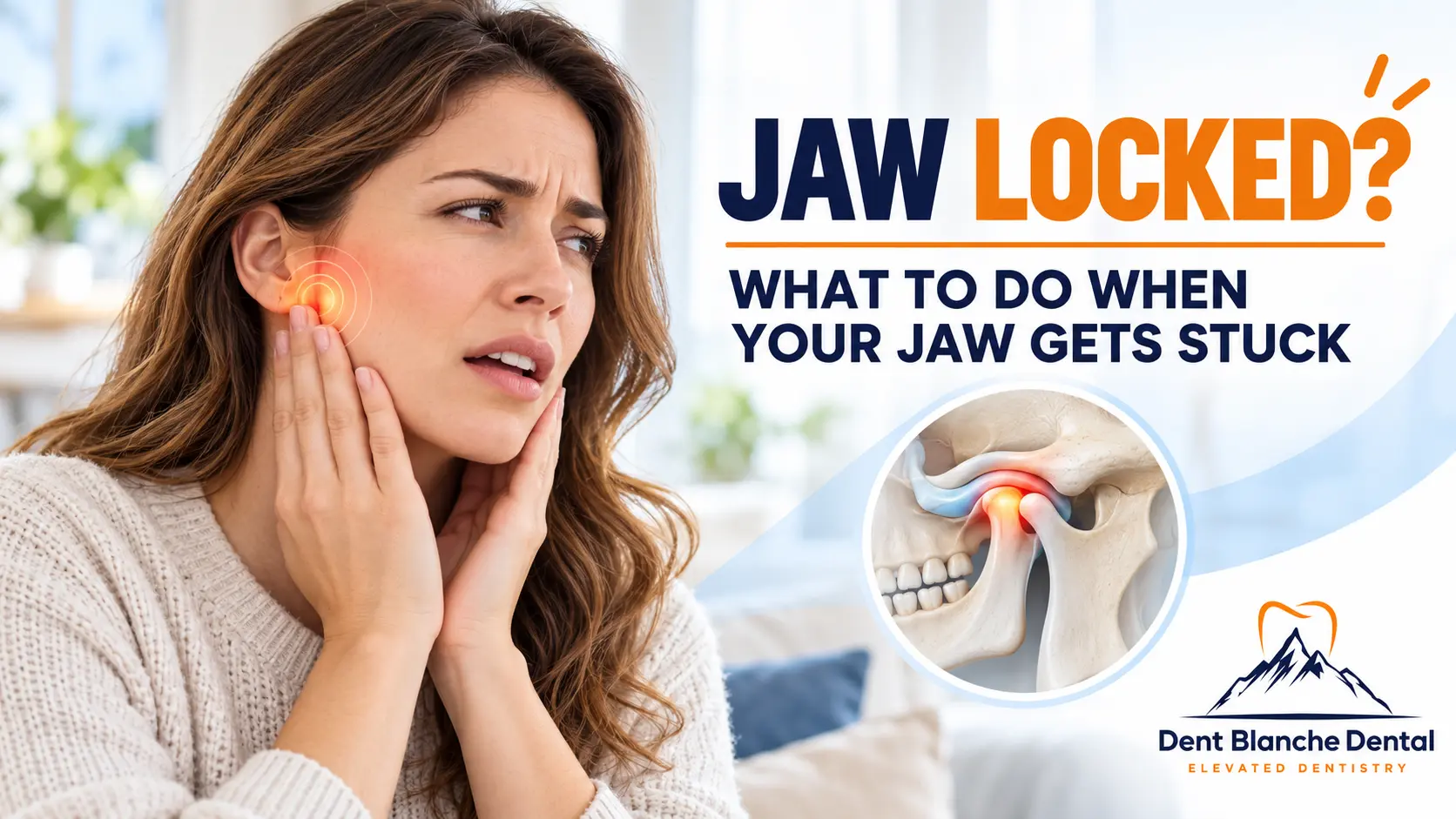
If your jaw is locked, do not force it open or closed. If your mouth will not open fully, rest your jaw, apply gentle warmth if comfortable, and contact a dentist or healthcare professional for prompt evaluation. If your jaw is locked open and you cannot close your mouth, seek urgent medical care because the jaw joint may be dislocated. Difficulty breathing or swallowing, significant trauma, or fever with severe swelling requires emergency evaluation.
A locked jaw may result from a temporomandibular joint (TMJ) problem, muscle spasm, injury, or another medical condition.
At Dent Blanche Dental in Princeton, NJ, Dr. Radwa Saad evaluates jaw discomfort, teeth grinding, and TMJ-related symptoms to help identify appropriate treatment options.
Overview: What Does It Mean When Your Jaw Is Locked?
A locked jaw occurs when you cannot open or close your mouth normally.
The problem may involve the temporomandibular joint, surrounding muscles, or structures that control jaw movement.
There are two main patterns:
- Closed lock: Your mouth will not open fully.
- Open lock: Your mouth becomes stuck open and will not close.
These conditions have different causes and may require different treatment.
Although some muscle-related episodes improve with rest, persistent or sudden jaw locking needs professional evaluation.
Key Takeaways
- Never force a locked jaw open or closed.
- A closed lock may involve TMJ disc displacement, muscle spasm, or restricted jaw movement.
- A jaw locked open may indicate dislocation and requires urgent medical evaluation.
- Warm compresses and jaw rest may help mild muscle-related symptoms.
- Teeth grinding and clenching can contribute to jaw pain and muscle tension.
- Repeated jaw locking deserves dental or medical evaluation.
- Jaw stiffness with fever, infection symptoms, trauma, or difficulty swallowing requires urgent care.
- Tetanus-related lockjaw is a medical emergency, not a routine TMJ problem.
What Should I Do If My Jaw Is Locked Right Now?
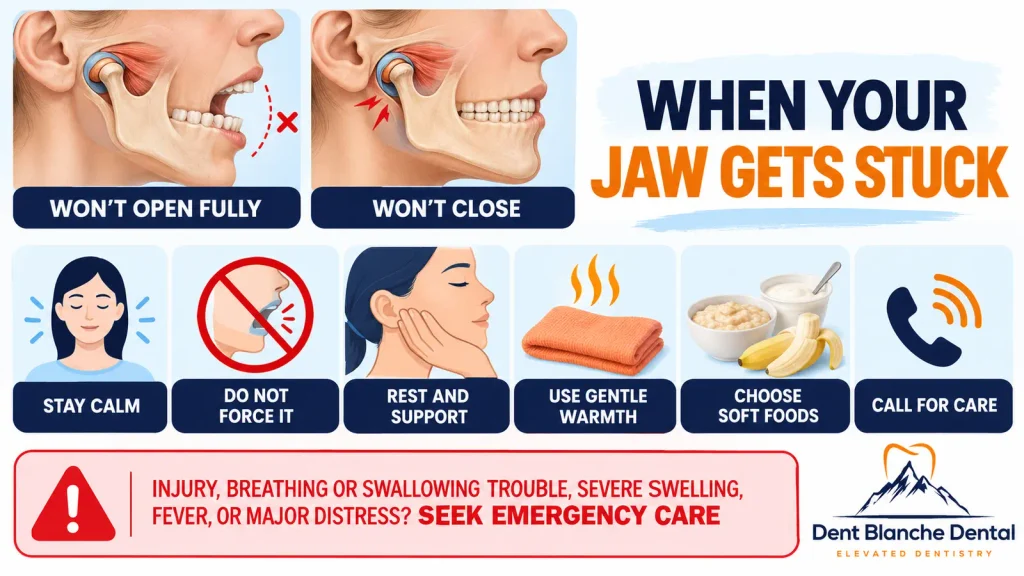
If your jaw suddenly becomes stuck, first determine whether you can open and close your mouth.
1. Stop Forcing Your Jaw
Do not attempt to push, pull, or manipulate your jaw into position.
Forceful movements may worsen a joint injury or dislocation.
2. Rest Your Jaw
Avoid chewing gum, hard foods, and excessive talking.
If your mouth can close normally, choose soft foods until your symptoms improve.
3. Apply Gentle Warmth
For mild muscle tightness without recent injury or concerning swelling, apply a comfortably warm compress to the jaw area for 10–15 minutes.
Stop if the heat increases discomfort.
4. Avoid Wide Opening
Limit wide yawning and unnecessary jaw movements.
Do not attempt aggressive stretching exercises while the jaw is locked.
5. Seek Appropriate Care
If your jaw is stuck open, seek urgent medical assessment.
If your jaw will not open normally, contact your dentist or healthcare professional promptly, especially if the restriction persists or affects eating and drinking.
When Should I Go to the Emergency Room for a Locked Jaw?
Most episodes of mild jaw tightness are not medical emergencies.
However, certain symptoms may indicate dislocation, infection, trauma, or another serious condition.
Seek emergency medical care if you have:
- Difficulty breathing or swallowing
- Rapidly increasing facial or neck swelling
- A jaw locked open that cannot close
- Jaw locking after significant facial trauma
- Fever with severe jaw stiffness or swelling
- Severe muscle spasms extending beyond the jaw
- Difficulty handling saliva or maintaining hydration
Can Lockjaw Be a Sign of Tetanus?
Yes. Tetanus is a rare but serious infection that can cause jaw stiffness, painful muscle spasms, and difficulty swallowing.
It is different from a typical TMJ disorder.
If severe jaw stiffness follows a contaminated wound, particularly when tetanus vaccination may be incomplete, seek immediate medical evaluation.
Do not assume severe jaw stiffness is simply a TMJ problem.
Why Does a Jaw Lock?
Your temporomandibular joints connect your lower jaw to your skull.
These joints work with muscles and an internal disc to allow chewing, speaking, and yawning.
When joint movement becomes restricted or the surrounding muscles tighten, the jaw may feel stuck.
What Are the Two Types of Jaw Locking?
Closed jaw lock
A closed lock limits how widely you can open your mouth.
One possible cause is TMJ disc displacement without reduction, in which the disc interferes with normal joint movement.
However, muscle spasm, inflammation, and other conditions can also restrict opening.
Open jaw lock
An open lock occurs when your jaw becomes stuck in an open position.
This may happen when the mandibular condyle moves out of its normal position and cannot return.
A true jaw dislocation requires professional assessment and often repositioning by a trained clinician.
What Causes a Locked Jaw?
Common causes include:
- TMJ disorders: Problems involving the jaw joint, disc, or surrounding muscles.
- Muscle spasms: Tight chewing muscles may restrict movement.
- Bruxism: Grinding or clenching can contribute to muscle pain and jaw fatigue.
- Dental procedures: Prolonged mouth opening or postoperative inflammation may cause temporary stiffness.
- Arthritis: Joint inflammation or degeneration may affect movement.
- Trauma: A fall or direct blow can injure or dislocate the jaw.
- Dental or throat infections: Certain infections can cause restricted opening, also called trismus.
- Tetanus: A rare but serious cause of severe jaw stiffness.
The correct treatment depends on the underlying diagnosis.
Why Is My Jaw Locking on One Side?
Jaw locking on one side may occur when one TMJ or its surrounding muscles are more affected than the other.
Possible symptoms include:
- Jaw getting stuck on one side
- Pain near one ear
- Clicking or popping
- Uneven jaw movement
- Difficulty opening fully
- Tenderness while chewing
If you’re asking, “Why does my jaw feel locked on one side?” the cause may involve joint mechanics, muscle tension, or inflammation.
However, symptoms alone cannot confirm a TMJ diagnosis.
Learn more about Jaw and Ear Pain.
When to See Your Dentist for Jaw Locking
Schedule an evaluation if:
- Your jaw keeps locking.
- You experience recurring jaw pain.
- Clicking accompanies painful or restricted movement.
- You wake with jaw stiffness.
- You have frequent headaches or facial tenderness.
- Your bite feels different.
- You struggle to chew or open your mouth comfortably.
A dentist may examine your jaw movement, bite, teeth, and chewing muscles.
Depending on the findings, treatment may involve self-care guidance, physical therapy, management of clenching, a properly designed oral appliance, or referral to a TMJ specialist.
Imaging may be recommended when necessary.
Jaw Locked: Frequently Asked Questions
Why Does My Jaw Keep Locking Over and Over?
Repeated jaw locking may involve a TMJ disorder, disc displacement, muscle dysfunction, or another condition.
Recurring episodes deserve evaluation rather than repeated attempts to unlock the jaw yourself.
Can Stress Lock Your Jaw?
Stress may increase jaw clenching and muscle tension.
However, not every locked jaw is caused by stress, and persistent movement restriction should be evaluated.
How Long Does a Locked Jaw Usually Last?
Duration varies. Muscle-related tightness may improve relatively quickly, while joint-related locking can persist.
There is no reliable waiting period that applies to every patient.
Can I Unlock My Jaw at Home?
Do not force your jaw into position. Gentle rest and warmth may help mild muscle tightness, but a true dislocation or persistent closed lock needs professional care.
What Should I Do If My Jaw Is Locked Open?
Seek urgent medical evaluation. A jaw locked open may indicate dislocation and should not be forced closed at home.
Why Is My Jaw Locking Up on One Side?
One-sided locking may involve a TMJ disc problem, muscle spasm, inflammation, or injury affecting that side.
A clinical examination can help identify the cause.
Is Lockjaw Common?
TMJ symptoms and jaw muscle discomfort are relatively common. However, true jaw locking is less common, and tetanus-related lockjaw is rare in vaccinated populations.
Can Teeth Grinding Cause Jaw Locking?
Bruxism can contribute to muscle tension and jaw discomfort. It may occur alongside TMJ disorders, but it does not explain every episode of locking.
What Is the Difference Between TMJ Lockjaw and Tetanus?
TMJ-related locking usually involves restricted joint movement or muscle dysfunction.
Tetanus is a serious infection that can cause widespread painful spasms, jaw stiffness, and swallowing or breathing problems.
Suspected tetanus requires emergency medical treatment.
How Do I Stop My Jaw From Locking Again?
Prevention depends on the cause. Your dentist may recommend avoiding excessive jaw strain, addressing clenching, physical therapy, or other individualized treatment.
Do not intentionally try to lock your jaw or reproduce painful locking episodes.
The Bottom Line
If your jaw is locked, avoid forcing movement.
A jaw that will not open normally may involve muscle dysfunction or a TMJ disorder. A jaw locked open may be dislocated and requires urgent medical care.
Persistent or recurring jaw locking deserves professional evaluation.
Most importantly, severe swelling, breathing or swallowing problems, trauma, or suspected tetanus should never be managed with home remedies.
Jaw Locking or TMJ Pain? Visit Dent Blanche Dental in Princeton, NJ
At Dent Blanche Dental, Dr. Radwa Saad and our team provide personalized evaluations for jaw discomfort, teeth grinding, and TMJ-related symptoms.
We can examine your symptoms, identify possible contributing factors, and discuss appropriate treatment or specialist referral when necessary.
Don’t ignore recurring jaw locking or persistent jaw pain.
Schedule Your Dental Appointment
Call: 609-890-1888
Dent Blanche Dental
3640 Lawrenceville Road
Princeton, NJ 08540